
Astrophysicists have studied how the future CTAO (Cherenkov Telescope Array Observatory) currently under construction in Chile at Paranal and in the Canary Islands at La Palma, could detect dark matter in the form of WIMPs (weakly interacting massive particles).
This work, led by Emmanuel Moulin (Department of Particle Physics at Irfu) and published in the Journal of Cosmology and Astroparticle Physics, shows that CTAO could be far more sensitive than current instruments in detecting these mysterious particles in the mass range of TeV and beyond.
This study examines the capability of the three types of experiments:
- searches conducted in particle accelerators (at the LHC),
- direct detection experiments (such as Xenon1T at the Gran Sasso laboratory or LUX-ZEPLIN dit LZ in the US)
- and the future CTAO (Cherenkov Telescope Array Observatory)
to detect dark matter signals using two theoretical frameworks: the Effective Field Theory (EFT) and Simplified Models. This common treatment allows for an objective comparison between these different experimental search/detection methods.
For WIMPs with masses close to the TeV (1,000 times the mass of a proton), CTAO could improve the sensitivity to dark matter annihilation signals by a factor of 10 compared to current atmospheric Cherenkov telescopes such as H.E.S.S., depending on the model. These results highlight the unique complementarity between CTAO, direct detection experiments, and collider searches to explore a wide range of dark matter scenarios. They also demonstrate that CTAO observations will provide access to the previously unexplored TeV mass range, which is inaccessible to other experiments.

Recap of experimental methods
- Collider searches (e.g., ATLAS, CMS): The goal is to directly produce WIMPs in proton-proton collisions, observing specific final states with missing energy (a typical signature of invisible particles) and traces of a potential mediator (an intermediate particle linking dark matter to the Standard Model).
- Direct detection (e.g., XENONnT, LZ, PandaX): The aim is to detect collisions between WIMPs and atomic nuclei or electrons in ultra-sensitive underground detectors, using materials such as liquid xenon or semiconductors.
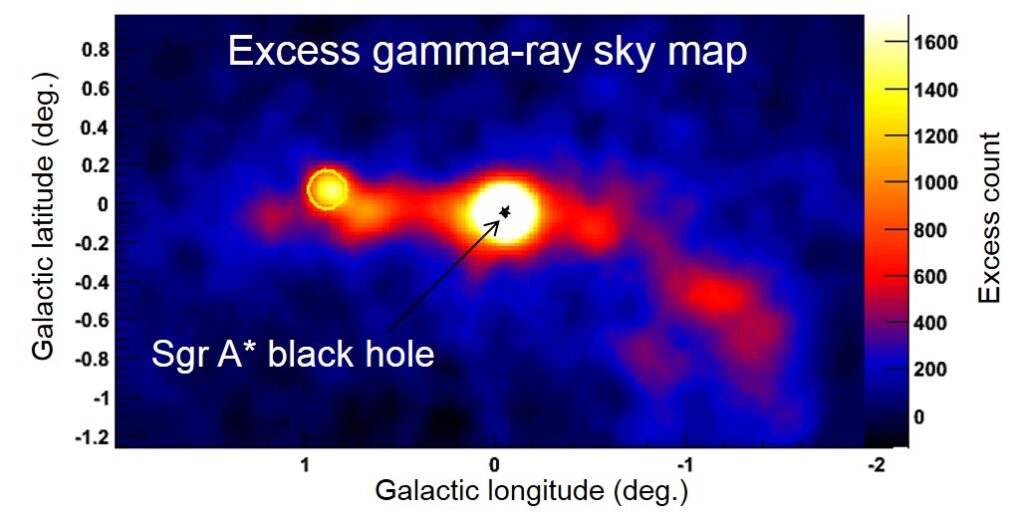
- Indirect detection (e.g., CTAO, H.E.S.S., Fermi-LAT): The search focuses on the products of WIMP annihilation or decay (gamma rays, neutrinos, charged particles) in the universe, particularly in the center of the Milky Way
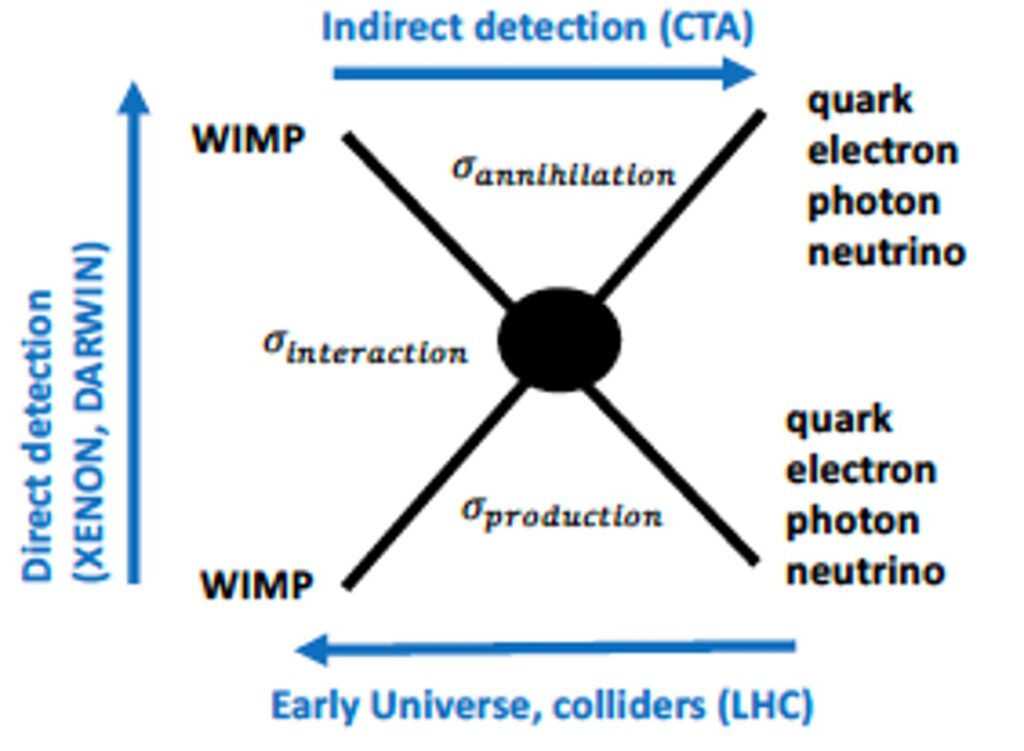
A unified approach to compare different experiments
Until now, each experiment (colliders, direct detection, gamma-ray observations) presented its results separately. To combine this data, physicists now use an Effective Field Theory (EFT): a method that “manually” adds a WIMP candidate and the necessary interactions with the fields of the Standard Model, where the parameters of the theory are the mass of the WIMP and M* (the mass scale of the EFT’s validity).
To overcome the limitations of this approach, a framework based on “simplified models” relative to complete theories like SUSY is introduced. This introduces new parameters:
- the mass of the mediator particle of the interaction, Mmed,
- and its coupling with the dark matter particle, gχ, and with quarks, gq.
In these two approaches, four types of interactions are considered (scalar OS, pseudo-scalar OP, vector OV, axial-vector OA), representing four distinct dark matter particles.
These analytical calculations allow for the calculation of annihilation and diffusion probabilities across different experiments, such as their annihilation rates in galaxies and diffusion on nuclei.
The key role of simulations for searches in the heart of our galaxy and in underground laboratories
To determine the distributions of dark matter particles (in number density and velocity) in our galaxy, scientists use advanced hydrodynamic simulations to predict these distributions at the center of our galaxy and near the Sun. Until now, simulations have primarily focused on dark matter alone, but these new simulations also incorporate the influence of ordinary matter (such as stars and gas) on the distribution and movement of dark matter in the Milky Way, particularly at its core and near the Sun, which are relevant for evaluating the expected flux in underground detectors.
These simulations, called Fire-2, are among the most precise to date. They rely notably on data from the Gaia satellite, which maps our galaxy with unprecedented precision. Thanks to them, researchers can better estimate how dark matter might be distributed in the Galaxy (and potentially produce detectable signals) and at what velocities.
Example of sensitivity results for experiments for two possible dark matter particle cases (vector coupling on the left and pseudo-vector coupling on the right):
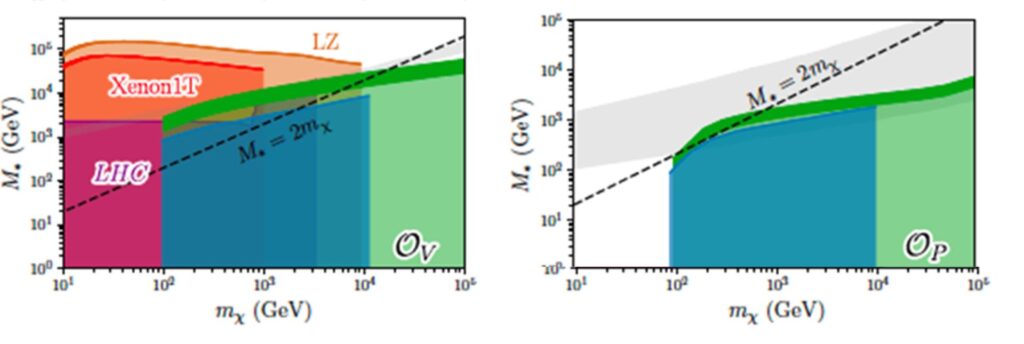
These two figures present current limits on the parameter M* (the mass scale of the Effective Field Theory) as a function of the WIMP mass mχ for the three experiments: those from direct searches with Xenon1T and LZ experiments, those conducted at the LHC, and those from CTAO in the center of the Milky Way.
- The contour M* = 2mχ is shown as a black dotted line, for which only the region above this line is kinematically accessible.
- For CTAO: blue zone = old simulation, green zone = updated current simulation with best inputs.
- The red and orange zones represent lower limits at 90% confidence level, derived respectively from Xenon1T and LZ measurements.
- The lower limit at 95% confidence level, resulting from a combination of ATLAS and CMS searches, is represented by the purple line.
- The grayed-out region represents the parameter space allowing for the recovery of the relic abundance of dark matter as measured by Planck.
Future CTAO observations (green zone) will probe M* values for WIMP masses up to 100 TeV. In the pseudo-scalar case (right), CTAO presents unique sensitivity and will probe M* and mχ values compatible with the dark matter abundance measured in the universe (grayed-out region).
With the accumulation of data from CTAO’s guaranteed dark matter observation program at the Galactic Center, the increase in statistics of very high-energy photons will further probe the parameter space of the EFT and be sensitive to larger values of the EFT mass scale.
Combined with these new theoretical approaches and the most up-to-date cosmological simulations, the CTAO TeV dark matter program is a key player because:
- it will probe the most relevant region in the parameter space of WIMP theories (mass, coupling),
- it will have unique sensitivity in the mass range between 1 and 100 TeV,
- it will probe the most privileged location to find WIMPs, namely the Galactic Center.
In the coming years, CTAO could well revolutionize the search for these WIMPs by detecting or excluding them, and will offer a more precise view of this cosmic mystery.
Contact: Emmanuel MOULIN (Irfu/DPhP)
Reference:
I. Reis et al., The complementary of CTAO, direct detection and collider searches for dark matter in Effective Field Theories and Simplified Models, JCAP 02 (2026) 015