Our understanding of nature is based on the concept of fundamental symmetries, which impart a particular structure to the Standard Model of particle physics (SM). Testing the validity of these symmetries is one of the best ways of validating the foundations of our current interpretation of nature’s behavior or, failing that, of searching for new physics. In particular, the asymmetry between matter and antimatter in the Universe raises troubling questions about the validity of some of the supposed symmetries. Neutrinos offer an ideal laboratory for testing these symmetries. Their characteristics, notably their mass and their possible Majorana nature, suggest new symmetries that may require an extension of the Standard Model.
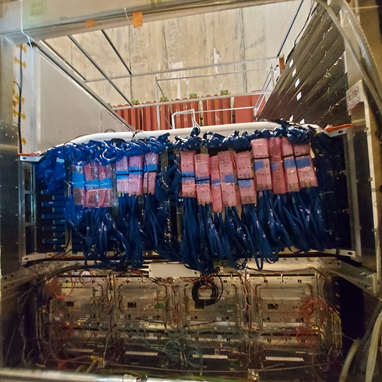
The DPhP has positioned itself to answer all open questions (nature of neutrinos, masses and properties of neutrinos, mass hierarchy) with current and future long baseline oscillation experiments (T2K, HK, DUNE), the study of neutrino properties, such as nucleus coherent scattering at the Chooz nuclear power plant (NUCLEUS), or of the nature of neutrinos, with next-generation neutrino-free beta decay experiments (CUORE, CUPID, BINGO, TINY). It is also involved in the study of antimatter behavior in the Earth’s gravitational field (GBAR). These studies are characterized by the deployment of a wide variety of detection technologies in very diverse environments (JPARC gas pedal, Chooz power plant, Modane, Canfranc or Gran Sasso underground laboratories). Some detection techniques are behind societal research and development programs, such as a new positron emission tomography technique for medical imaging (ClearMind).
Groups
-
The discovery of neutrino oscillations, which won the 2015 Nobel Prize, established that these particles have a non-zero mass, contradicting the Standard Model (SM). The DPhP group is involved in several neutrino oscillation experiments to search for a difference between neutrino and antineutrino oscillations, a potential sign of a violation of CP symmetry. Such a…
-
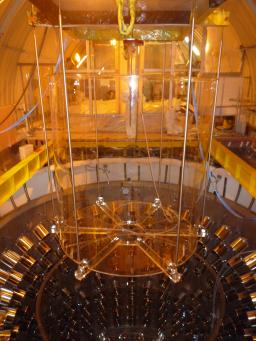
The Double-Chooz collaboration gathers about 160 physicists and engineers from 38 Institutes in 8 countries. Located next to the Chooz nuclear plant in the French Ardennes, the experiment is…
-
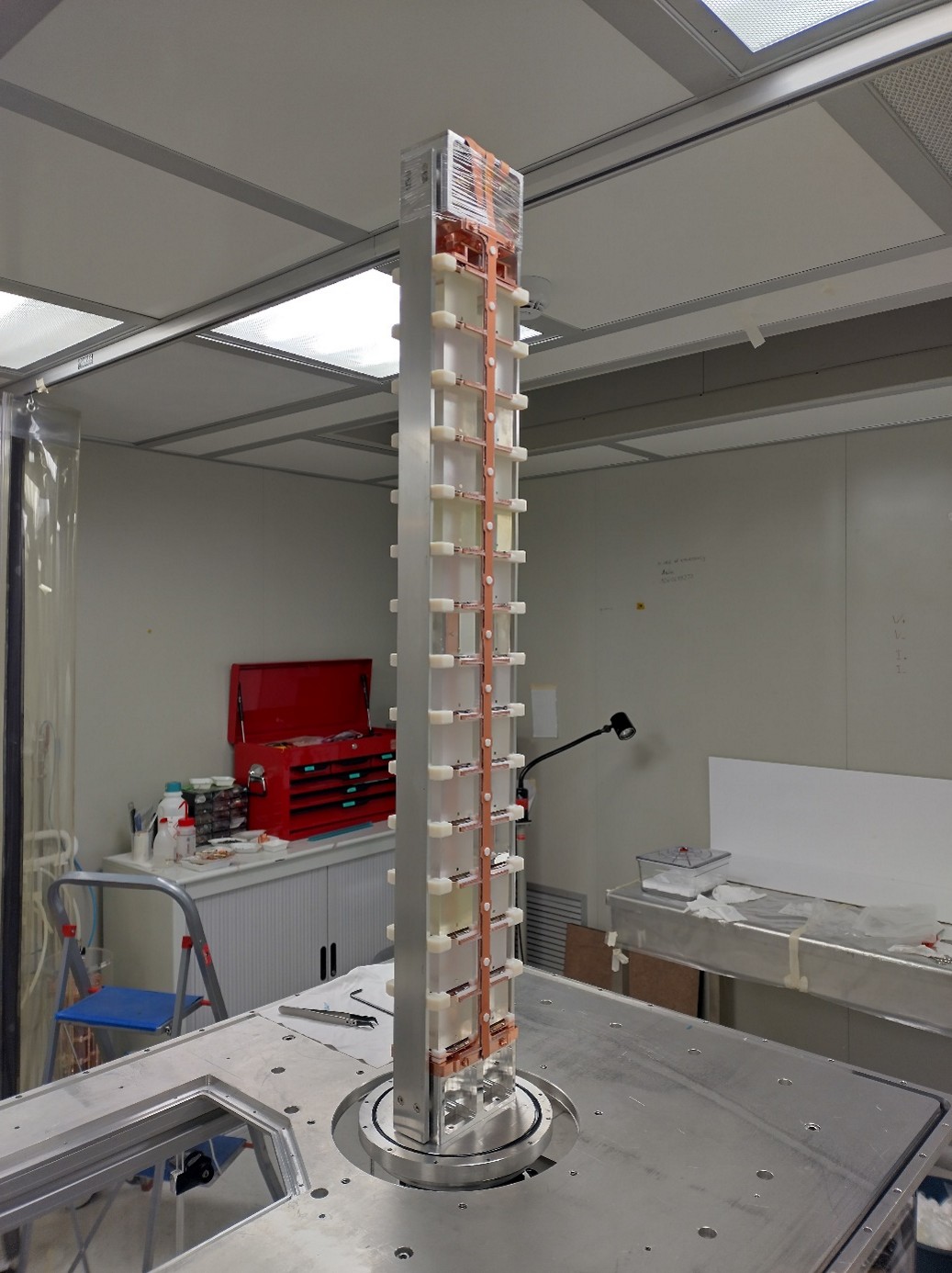
Double beta decay without neutrino emission (0νββ) is a hypothetical nuclear process, never observed, that would violate the conservation of lepton number. Its discovery would establish that neutrino and antineutrino are the same particle – a Majorana neutrino – and provide essential information on the absolute scale and order of neutrino masses. Among experimental techniques,…
-
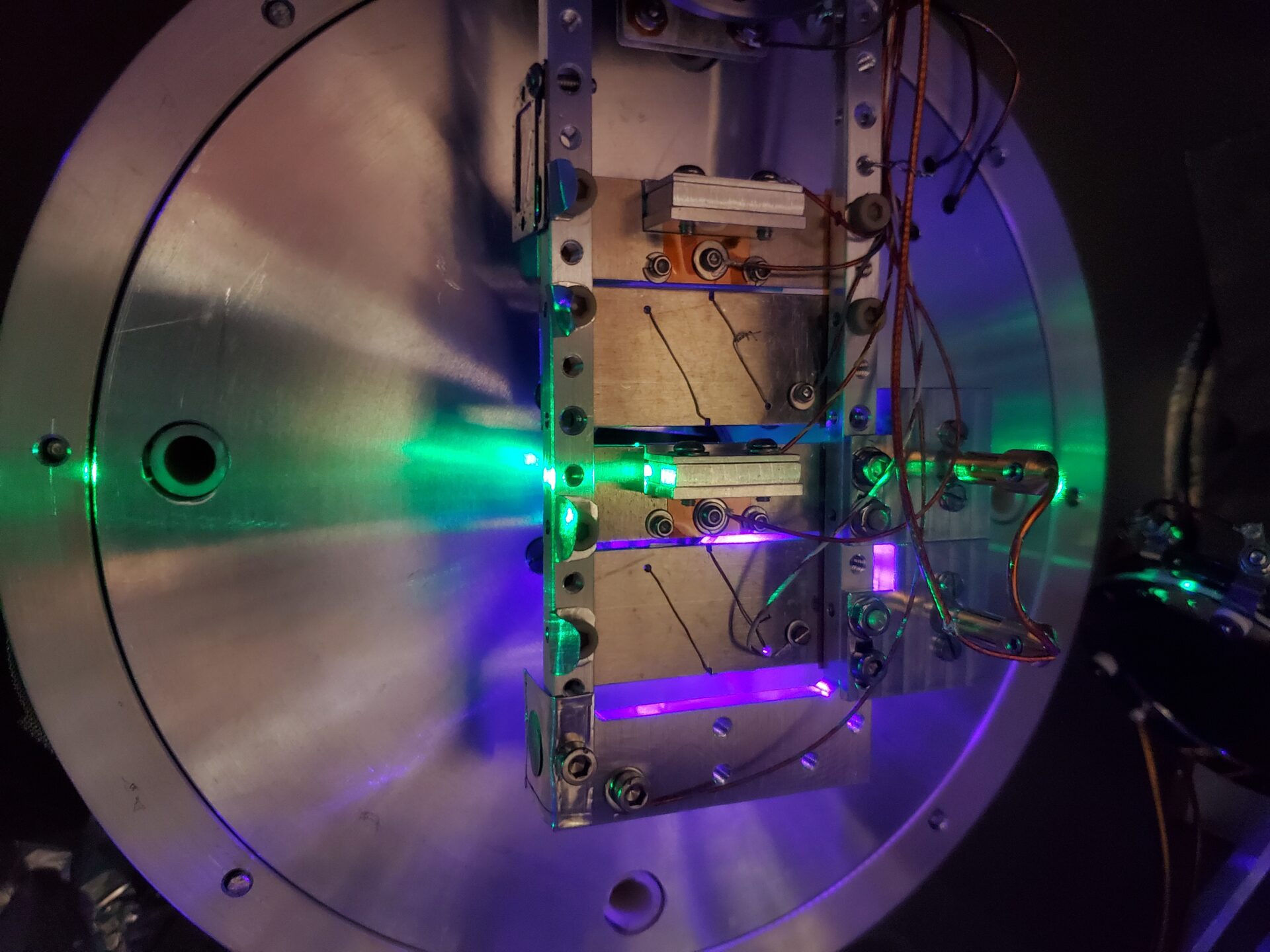
The GBAR experiment, initiated at the IRFU, aims to measure the gravitational acceleration of a free-falling antihydrogen atom, in order to test the behavior of antimatter in the Earth’s gravitational field. The main challenge lies in the extreme cooling of these atoms, initially produced with kinetic energies in the keV range but needing to be…
-
Ionizing radiation detectors with very high temporal resolution are key elements not only in particle physics, but also in medical imaging. Capitalizing on its expertise in gamma radiation detection (scintillating crystal calorimeters) and in fast analog and digital electronics, the Group has been developing detectors for functional PET medical imaging since 2009. A PET image…