The Standard Model of particle physics (SM) is a theory that describes the interactions between matter particles (leptons and quarks) and their interactions (via bosons: photon, Z, W, and gluons) as well as the Higgs boson, introduced to explain the non-zero masses of the W and Z bosons and discovered at the LHC in 2012. From just a few parameters, MS predicts scattering cross sections, distributions and decay rates as observed experimentally.
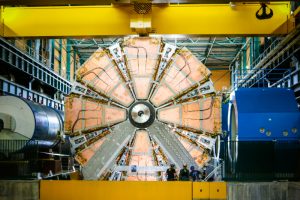
The DPhP is at the heart of the IRFU’s major contributions to establishing the MS and verifying its predictions, in particular, since the turn of the millennium, at the LHC. DPhP physicists are involved in the generalist ATLAS and CMS experiments, which led to the discovery of the Higgs boson, with expertise in Higgs, top and electroweak quark physics; in the rejuvenation of the two detectors in preparation for the high-luminosity phase of the LHC (HL-LHC) and the preparation of analyses; and in the preparation of the future with longer-term projects for future gas pedals such as the International Linear Collider (ILC), the Future Circular Collider (FCC), and the Muon Collider (MuCol).
Groups
-
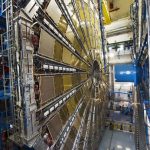
The ATLAS Collaboration gathers close to 3,000 physicists, from 174 institutes in 38 countries. ATLAS is one of the two general-purpose experiments at the CERN Large Hadron Collider (LHC). ATLAS has…
-
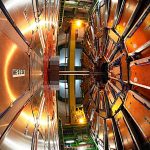
The CMS Collaboration gathers close to 2,500 physicists, from 180 institutes in 43 countries. CMS is one of the two general-purpose experiments at the CERN Large Hadron Collider (LHC). CMS has…
-
With the discovery of the Higgs boson in 2012, several concepts for future lepton colliders are emerging: linear or circular, electron-positron or muon. DPhP physicists are working on the physics case for the various machines of the future, and on the design of suitable detectors. For a future linear collider, Irfu teams are working on…