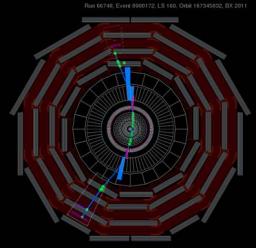
On November 14, 2008, the Compact Muon Solenoid (CMS) successfully generated a nominal magnetic field of 4 tesla. This success rewards IRFU efforts for the design and construction of what constitutes the largest superconducting solenoid magnet in the world. Over a period of approximately one month, CMS teams conducted a continuous data acquisition campaign with the detector operating under nominal conditions. Approximately 300 million cosmic events were recorded. This also provided an excellent opportunity to showcase the specific expertise of IRFU teams, particularly in areas such as detection systems, electronics, trace data reconstruction techniques and laser control systems.
The high energy part of the SPIRAL2 linear accelerator (new GANIL1 accelerator scheduled for implementation in 2012) uses two types of superconducting cavities. IRFU's Accelerator, Cryogenics and Magnetism Department is responsible for the design and development of 12 cryomodules2 of the first type, to be installed at the injector output.
On December 8, 2008, the qualification prototype cryomodule was successfully tested at full power. The superconducting cavity attained an accelerating gradient of 10.3 MV/m (million volts per meter), far greater than the specified value of 6.5 MV/m.
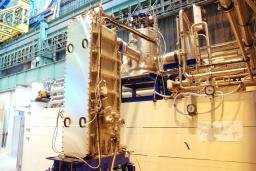
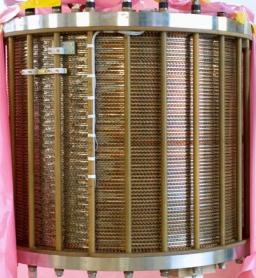
The 11.75 tonne whole body Iseult magnet to be installed in the Neurospin centre in 2012 will push back the boundaries of cerebral imaging. A key step in the success of this Franco-German project is the development of the SEHT test station in which a nominal field strength of 8 teslas was successfully achieved in early October 2008
Part of the IFMIF-EVEDA1) project consists of the construction of a prototype deuton2) accelerator at Rokkasho-Mura in Japan. The accelerator is due to enter service in 2013. The purpose of the EVEDA phase is to validate the IFMIF project which aims to investigate the strength of materials subjected to a high neutron flux in order to characterise the materials to be used in the construction of DEMO3).
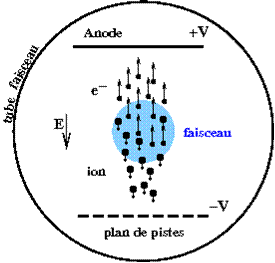
This high-current linear accelerator will produce a 125 mA beam of deutons with energies of around 10 MeV. A number of diagnostic stations need to be installed along the line in order to guide the beam through the various elements of the accelerator. The purpose of these diagnostic stations is to provide data on the beam profile, energy, position, etc. at each of the station positions. With a maximum beam power of 1.25 MW, the use of any form of measurement device that interacts with the beam is impossible as it would be immediately destroyed!
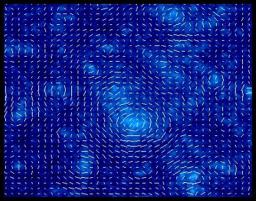
Jean-Luc Starck, an experienced research scientist at IRFU (the CEA Institute for Research on the Fundamental Laws of the Universe) was awarded a 2.2 million euro grant spread over five years under the 7th European research and development framework programme (FP7). The grant comes in recognition of Mr Starck's research project in statistics, signal and image processing and its applications to astrophysics.
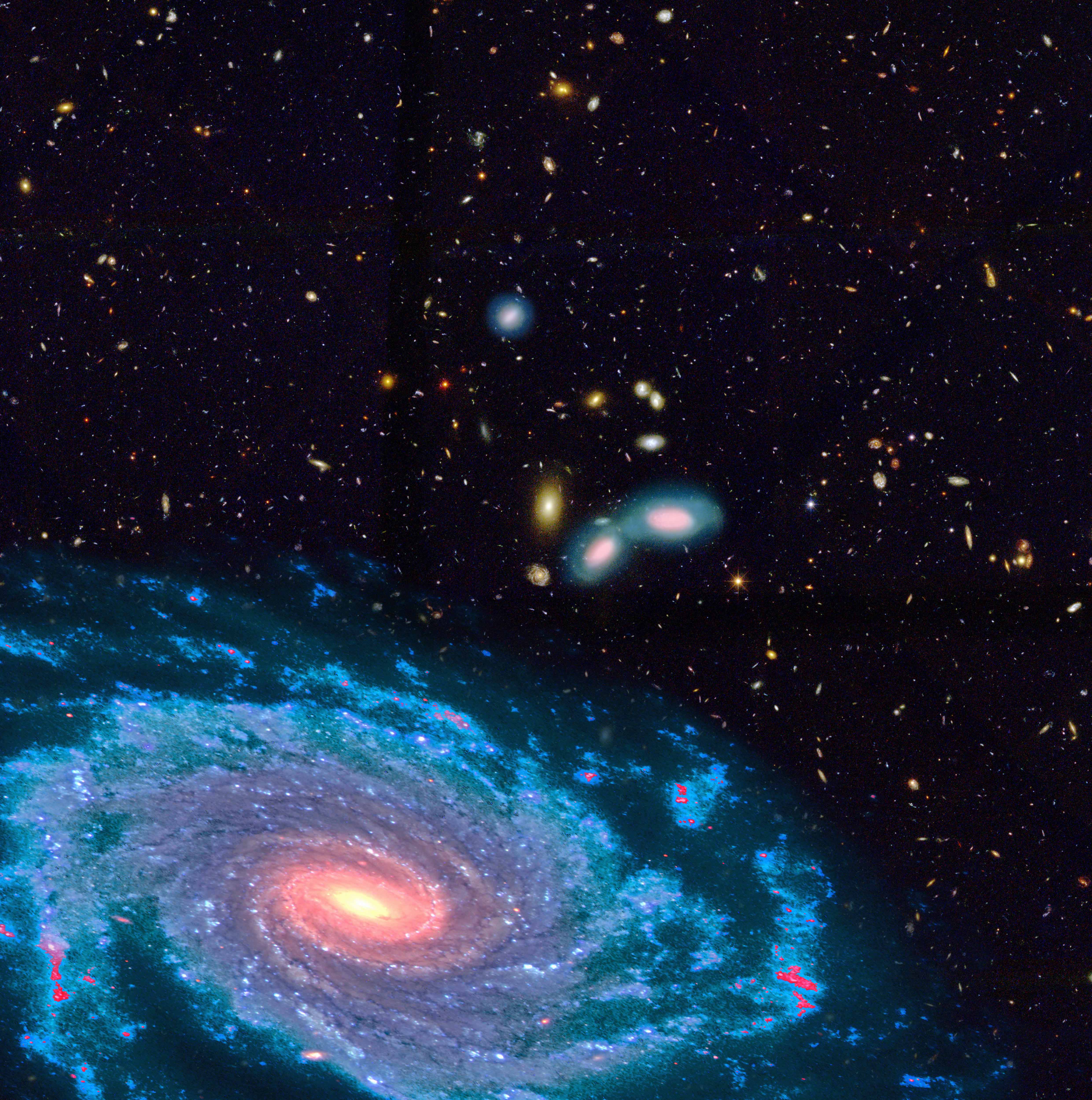
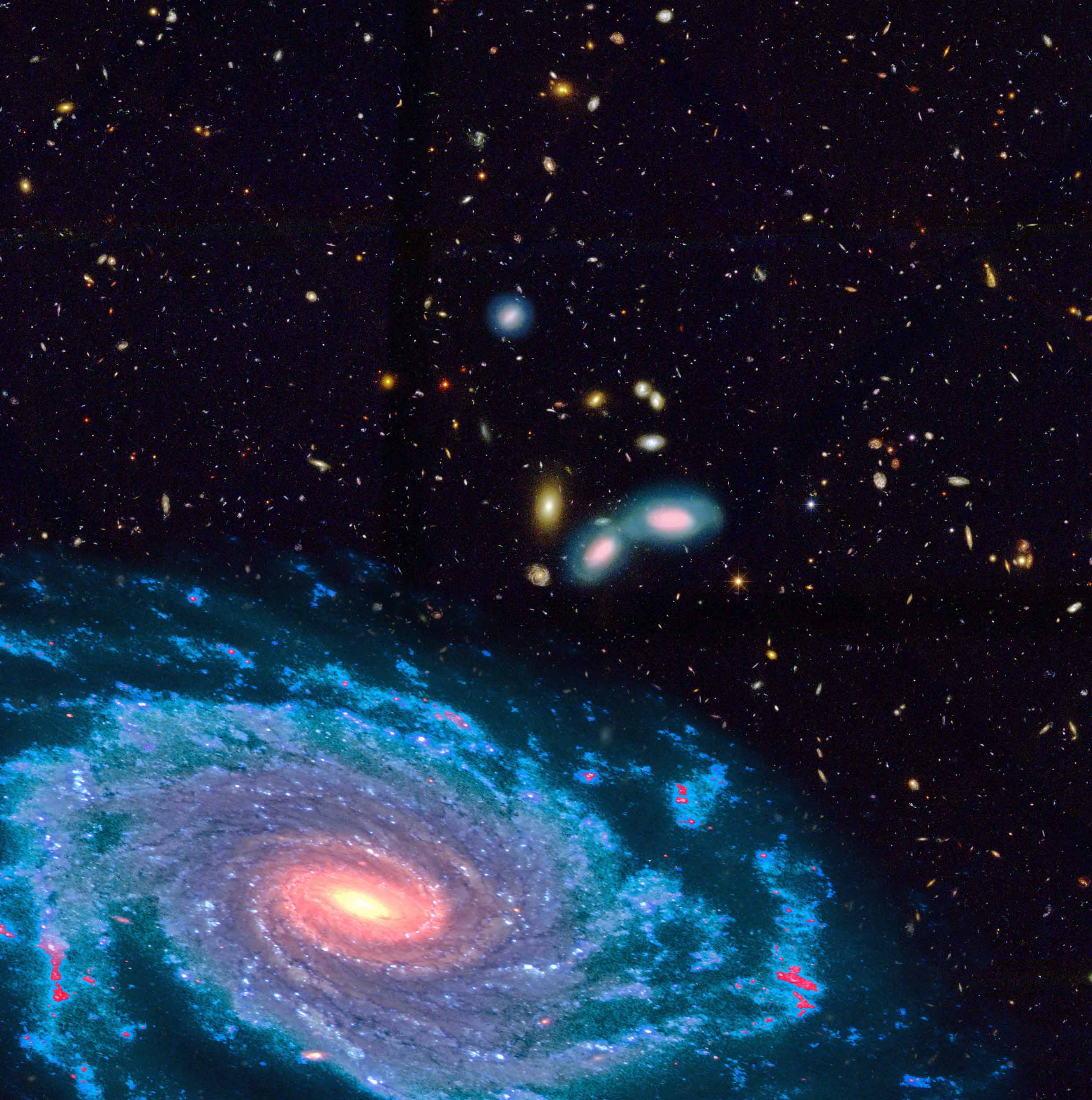
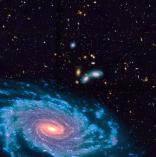
An international team of astronomers lead by scientists of the Astrophysics Division of CEA-IRFU has discovered large molecular gas reservoirs - the combustible for forming new stars - hosted in ordinary massive galaxies in the young, distant Universe. The discovery has been made with the IRAM Plateau de Bure Interferometer located in the French Alps, observing at millimeter wavelengths. This finding indicates that massive galaxies built major fractions of their stars in a nearly continuous way, and not on very rapid bursts as thought before, and open new major possibilities for understanding galaxy formation at high redshifts. The results are published in the January 2008 issue of the Astrophysical Journal.
Image credits: MPIA Heidelberg (Hi_res 1.7Mo / Med_res 0.4Mo)
On November 14, 2008, the Compact Muon Solenoid (CMS) successfully generated a nominal magnetic field of 4 tesla. This success rewards IRFU efforts for the design and construction of what constitutes the largest superconducting solenoid magnet in the world. Over a period of approximately one month, CMS teams conducted a continuous data acquisition campaign with the detector operating under nominal conditions. Approximately 300 million cosmic events were recorded. This also provided an excellent opportunity to showcase the specific expertise of IRFU teams, particularly in areas such as detection systems, electronics, trace data reconstruction techniques and laser control systems.
Jean-Luc Starck, an experienced research scientist at IRFU (the CEA Institute for Research on the Fundamental Laws of the Universe) was awarded a 2.2 million euro grant spread over five years under the 7th European research and development framework programme (FP7). The grant comes in recognition of Mr Starck's research project in statistics, signal and image processing and its applications to astrophysics.
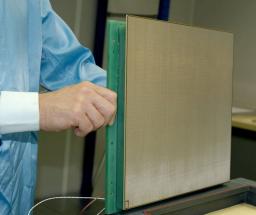
The Micromesh Gaseous Structure (Micromegas) detectors designed and developed by IRFU researchers have been used increasingly over the past few years in the field of particle and radiation detection for physics research, and show strong potential for nuclear, biomedical and industrial instrumentation applications. Recent R&D efforts have led to the development of new manufacturing processes that improve the performance and scope of application of these detectors. The second generation of Micromegas detectors is already being used in several international physics experiments that have yielded excellent results since the fall of 2008.
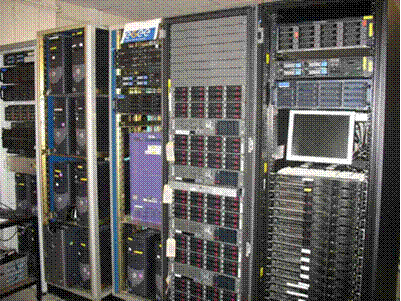
Shortly after the LHC started up on the 10th September 2008 at 9:30 am, the detectors recorded the first events resulting from proton collisions in the beam detectors. The data processing scheme that had been planned for such a long time immediately came into action with the distribution of data to the Tier0 data centre, then the eleven Tier1 data centres, and finally the Tier2 data centres.
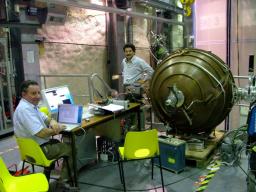
This large gas detector is based on a simple, strong and low-cost spherical geometry. The detector combines a large drift volume and proportional amplification in order to detect ionising particles. A metal ball at the centre of the sphere is held at a high voltage causing an avalanche effect in the gas surrounding it.
Target applications:
- Low energy neutrino physics
- industrial applications involving the detection of neutrons
Part of the IFMIF-EVEDA1) project consists of the construction of a prototype deuton2) accelerator at Rokkasho-Mura in Japan. The accelerator is due to enter service in 2013. The purpose of the EVEDA phase is to validate the IFMIF project which aims to investigate the strength of materials subjected to a high neutron flux in order to characterise the materials to be used in the construction of DEMO3).
This high-current linear accelerator will produce a 125 mA beam of deutons with energies of around 10 MeV. A number of diagnostic stations need to be installed along the line in order to guide the beam through the various elements of the accelerator. The purpose of these diagnostic stations is to provide data on the beam profile, energy, position, etc. at each of the station positions. With a maximum beam power of 1.25 MW, the use of any form of measurement device that interacts with the beam is impossible as it would be immediately destroyed!
The high energy part of the SPIRAL2 linear accelerator (new GANIL1 accelerator scheduled for implementation in 2012) uses two types of superconducting cavities. IRFU's Accelerator, Cryogenics and Magnetism Department is responsible for the design and development of 12 cryomodules2 of the first type, to be installed at the injector output.
On December 8, 2008, the qualification prototype cryomodule was successfully tested at full power. The superconducting cavity attained an accelerating gradient of 10.3 MV/m (million volts per meter), far greater than the specified value of 6.5 MV/m.
Shortly after the LHC started up on the 10th September 2008 at 9:30 am, the detectors recorded the first events resulting from proton collisions in the beam detectors. The data processing scheme that had been planned for such a long time immediately came into action with the distribution of data to the Tier0 data centre, then the eleven Tier1 data centres, and finally the Tier2 data centres.
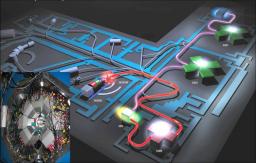
The shape of an atomic nucleus reflects the shell structure of the protons and neutrons of which it is formed. If the shells are completely filled, we speak of a "magic" nucleus, which is spherical in shape. Most nuclei, however, tend to be deformed because their shells are only partially filled. The most commonly encountered shapes are elongated (prolate) or flattened (oblate); these shapes can change from on nucleus to its neighbour by adding or removing a proton or neutron. In some cases it is sufficient to rearrange the protons or neutrons within the same nucleus to change its shape. The same nucleus can therefore assume different shapes corresponding to states of different energy. If such states come close in energy (one thousandth of the binding energy of the nucleus or so), the different shapes can mix. According to the laws of quantum mechanics, the nucleus can coexist in different shapes (e.g. elongated and flattened) at the same time. Such shape coexistence was observed in light krypton and selenium isotopes in a series of experiments performed by a team of researchers from the Nuclear Physics Department (SPhN) of IRFU .
On November 14, 2008, the Compact Muon Solenoid (CMS) successfully generated a nominal magnetic field of 4 tesla. This success rewards IRFU efforts for the design and construction of what constitutes the largest superconducting solenoid magnet in the world. Over a period of approximately one month, CMS teams conducted a continuous data acquisition campaign with the detector operating under nominal conditions. Approximately 300 million cosmic events were recorded. This also provided an excellent opportunity to showcase the specific expertise of IRFU teams, particularly in areas such as detection systems, electronics, trace data reconstruction techniques and laser control systems.
Shortly after the LHC started up on the 10th September 2008 at 9:30 am, the detectors recorded the first events resulting from proton collisions in the beam detectors. The data processing scheme that had been planned for such a long time immediately came into action with the distribution of data to the Tier0 data centre, then the eleven Tier1 data centres, and finally the Tier2 data centres.
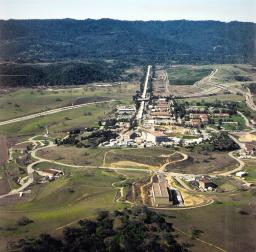
Scientists from the CDF and DZero collaborations at the U.S. Department of Energy's Fermilab have combined Tevatron data from the two experiments to advance the quest for the long-sought Higgs boson. They have presented their results on August 3rd at the International Conference on High Energy Physics in

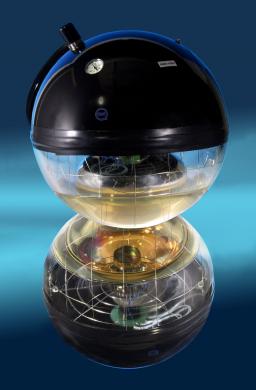
The last two lines of the ANTARES detector were connected and powered at a depth of 2500 m on the Mediterranean seabed during the night of May 30, 2008. This brings the number of lines to twelve and completes the construction phase of the largest underwater neutrino telescope ever built.
The lines were immersed a few weeks earlier, close to the other lines that have been tracking cosmic neutrinos since 2006. These particles may be able to tell us more about the most violent phenomena in the Universe.
The event rewards the efforts of the European ANTARES collaboration1 and, more especially, of CEA-IRFU, which has been a major contributor to the project.
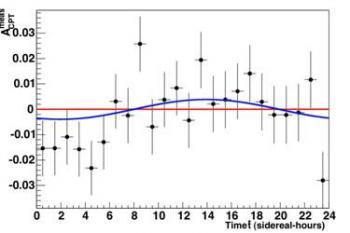
The BaBar experiment running on the PEP-II accelerator at SLAC (California) has been collecting data for ten years and has recorded sufficient events to probe the most subtle aspects of the Standard Model of particle physics and quantum field theory. By analysing the behaviour over time of the B-meson particle-antiparticle pairs produced in abundance, a team of researchers including participants from IRFU/SPP has been able to demonstrate that the Universe has no preferred direction, and therefore that Lorentz symmetry, touchstone of modern physics, still holds. This original work is similar in concept to the famous Michelson-Morley experiment that demonstrated the symmetry of the speed of light.
On November 14, 2008, the Compact Muon Solenoid (CMS) successfully generated a nominal magnetic field of 4 tesla. This success rewards IRFU efforts for the design and construction of what constitutes the largest superconducting solenoid magnet in the world. Over a period of approximately one month, CMS teams conducted a continuous data acquisition campaign with the detector operating under nominal conditions. Approximately 300 million cosmic events were recorded. This also provided an excellent opportunity to showcase the specific expertise of IRFU teams, particularly in areas such as detection systems, electronics, trace data reconstruction techniques and laser control systems.
The high energy part of the SPIRAL2 linear accelerator (new GANIL1 accelerator scheduled for implementation in 2012) uses two types of superconducting cavities. IRFU's Accelerator, Cryogenics and Magnetism Department is responsible for the design and development of 12 cryomodules2 of the first type, to be installed at the injector output.
On December 8, 2008, the qualification prototype cryomodule was successfully tested at full power. The superconducting cavity attained an accelerating gradient of 10.3 MV/m (million volts per meter), far greater than the specified value of 6.5 MV/m.
The 11.75 tonne whole body Iseult magnet to be installed in the Neurospin centre in 2012 will push back the boundaries of cerebral imaging. A key step in the success of this Franco-German project is the development of the SEHT test station in which a nominal field strength of 8 teslas was successfully achieved in early October 2008
Part of the IFMIF-EVEDA1) project consists of the construction of a prototype deuton2) accelerator at Rokkasho-Mura in Japan. The accelerator is due to enter service in 2013. The purpose of the EVEDA phase is to validate the IFMIF project which aims to investigate the strength of materials subjected to a high neutron flux in order to characterise the materials to be used in the construction of DEMO3).
This high-current linear accelerator will produce a 125 mA beam of deutons with energies of around 10 MeV. A number of diagnostic stations need to be installed along the line in order to guide the beam through the various elements of the accelerator. The purpose of these diagnostic stations is to provide data on the beam profile, energy, position, etc. at each of the station positions. With a maximum beam power of 1.25 MW, the use of any form of measurement device that interacts with the beam is impossible as it would be immediately destroyed!