
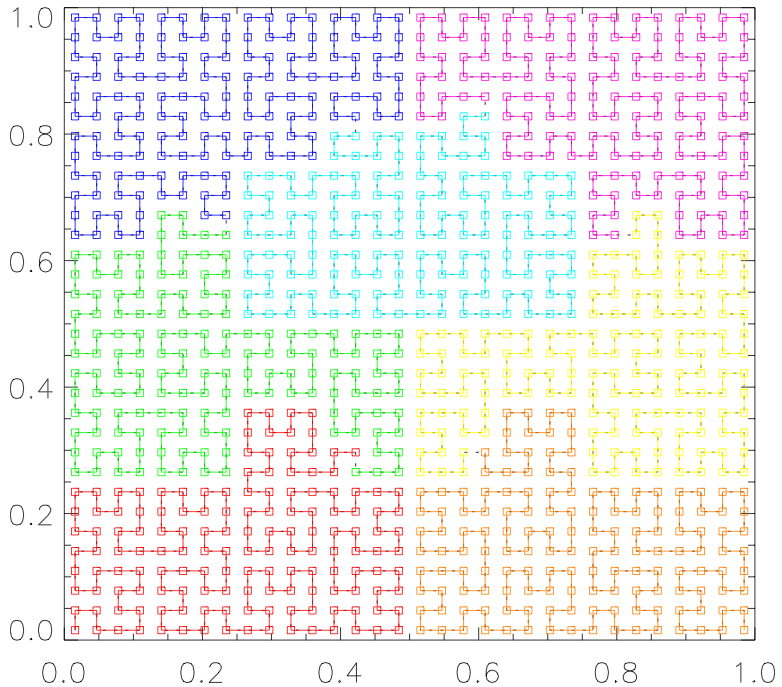
Examples of domain decomposition used in
RAMSES to perform parallel computing.
RAMSES was developped in Saclay to study large scale structure and galaxy formation.
It is now a rather flexible package to be used for general purpose simulations in self-gravitating fluid dynamics.
It is written in Fortran 90 with extensive use of the MPI library.
The current version is 1.0: it is a free software for non-commercial use only.
RAMSES
This code is a grid-based hydro solver with adaptive mesh refinement. The data structure is called a "fully threaded tree". As opposed to "patch-based AMR", cells are refined on a cell by cell basis: it is therefore called a "tree-based AMR". A very simple interface based on "Fortran namelists" can be used to specify runtime parameters. A few routines can be modified to set more complex initial or boundary conditions. The 4 main modules are:
- the AMR module with grid refinement, parallel communications and time steping.
- the hydro module with a second-order unsplit Godunov solver with various slope limiters and Riemann solvers.
- the N body module for colisionneless particles dynamics
- the Poisson module with a multigrid solver for the coarse grid and a Conjugate-Gradient solver on the fine grids.
Download
Go to the Download Page .
Credit
RAMSES was written by Romain TEYSSIER, and is under CEA Copyright.
This software is governed by the CeCILL license under French law and abiding by the rules of distribution of free software. You can use, modify and/or redistribute the software under the terms of the CeCILL license as circulated by CEA, CNRS and INRIA (see http://www.cecill.info ).
As a counterpart to the access to the source code and rights to copy, modify and redistribute granted by the license, users are provided only with a limited warranty and the software's author, the holder of the economic rights, and the successive licensors have only limited liability. In this respect, the user's attention is drawn to the risks associated with loading, using, modifying and/or developing or reproducing the software by the user in light of its specific status of free software, that may mean that it is complicated to manipulate, and that also therefore means that it is reserved for developers and experienced professionals having in-depth IT knowledge. Users are therefore encouraged to load and test the software's suitability as regards their requirements in conditions enabling the security of their systems and/or data to be ensured and, more generally, to use and operate it in the same conditions as regards security.
The fact that you are presently reading this means that you have had knowledge of the CeCILL license and that you accept its terms.
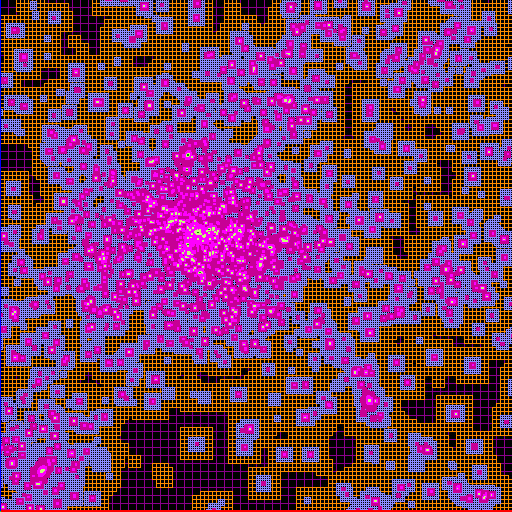
Exemple of AMR grid obtained during a high-resolution cosmological simulation. Each color corresponds to a given level of refinement. Only oct boundaries are shown for clarity.
• Détection des rayonnements Modélisation, calcul, analyse des données
• Le Département d'Astrophysique // UMR AIM (DAp) • The Astrophysics Division (DAp)